
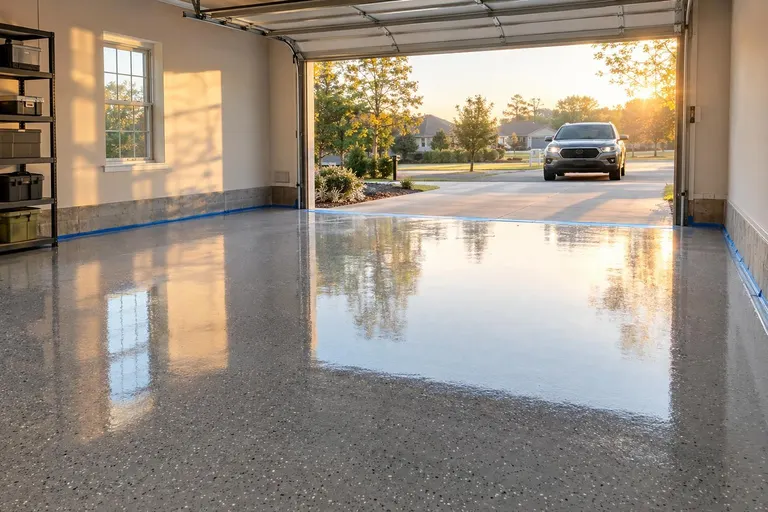
How a floor goes in, start to finish.
Six steps, one working day for most garages. Here is exactly what happens, and why each step matters.
Scroll to pull the floor apart.
- 01
Diamond grind
We open the concrete with a diamond grinder and a dust-controlled vacuum, removing sealers, old coatings and laitance so the new floor can bite in. This is the step that decides how long your floor lasts.
Surface prep - 02
Repair and fill
Cracks are routed and filled, pits and spalls patched, control joints filled with a flexible joint filler. The slab becomes flat, sound and ready.
Crack and joint repair - 03
Base coat
A fast-curing polyurea or polyaspartic base coat is rolled on in the color you chose. It bonds to the concrete and sets the tone of the whole floor.
Color base - 04
Flake broadcast
While the base is wet, decorative vinyl flakes are thrown by hand into the air so they fall evenly. Full, half or light coverage is your call.
Decorative flakes - 05
Scrape and seal
Loose flakes are scraped and vacuumed away, leaving a smooth, even texture. Any rough edges are lightly sanded before sealing.
Texture control - 06
Clear topcoat
A UV-stable polyaspartic topcoat locks everything in, adds depth and gloss, and gives the floor its stain, chemical and hot-tire resistance.
Polyaspartic clear
What your day looks like
- AM
Prep
We arrive, protect your walls and doors and start grinding and repairs while the garage is still cool.
- MID
Color and flakes
Base coat goes down and flakes are broadcast by hand while it is wet.
- PM
Scrape and seal
Loose flakes are scraped away and the clear topcoat locks it in.
- EVE
Walk-through
You inspect the floor and get written cure and care instructions.
How to get ready
- Move vehicles out of the garage, and clear what you can from the floor.
- Tell us about pets, children and any area we should not use for equipment.
- Make sure we can reach water and power, or tell us if we will need to bring our own.
- Plan to keep the garage free of traffic until the cure guidance says it is ready.
Questions, answered
How long does a garage floor coating take?
Most two-car garages are finished in one working day: diamond grinding, crack repair, base coat, flakes and clear topcoat. Large floors, heavy repairs or moisture issues can add a day, and we tell you before we start.
What is the difference between polyurea and polyaspartic?
Polyaspartic is a type of aliphatic polyurea. Both cure fast and are tough. We use polyurea or polyaspartic for the color and flake layers and a UV-stable polyaspartic clear coat on top, so the floor resists hot tires and does not yellow.
How much does a garage floor coating cost?
Published U.S. ranges are roughly $3 to $12 per square foot installed, with epoxy at the low end and polyurea and polyaspartic at the high end. The Cost Estimator on this site gives a planning range; a free assessment gives a firm written price.
Will the coating peel?
Peeling almost always traces back to poor preparation or moisture. We diamond grind every slab, repair it, check moisture and choose a system that suits your garage, which is why our floors are built to stay bonded.
When can I walk and park on the new floor?
Typically you can walk on it the same day. Vehicles usually return in about a day or two, depending on temperature and the system. You get written cure guidance on install day.
Ready to see it happen in your garage?
Start with a free assessment.